
Fields of Corn
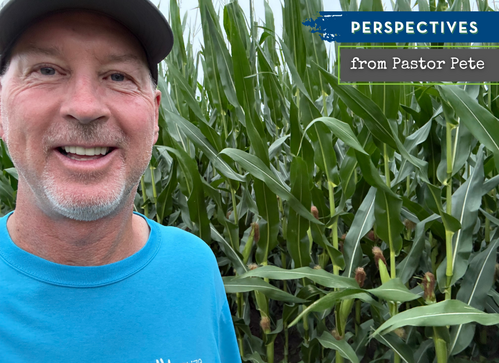
As an Iowa native, I have a love-hate relationship with cornfields.
Perhaps you share my love for these fields and the fruit that flows from them. It would be a pity if you had never savored the buttery juice of summer sweet corn dribbling down over your chin, arms and elbows. And if you’ve driven the length of the “flyover states,” you’ve certainly come to appreciate the hypnotic monotony of green corn, with its silky heads of hair swaying to the music of the Midwestern wind.
Yes, there’s lots to love about cornfields. But I should probably explain the source of my strong dislike.
My first paying job was corn detasseling. And for those who don’t know a hoe from a hornet, this is the tedious process of removing the tassels—the pollen-producing stalks at the top of corn plants—from selected rows.*
Picture a busload of teenagers being dropped off at the end of a long field and disappearing into a thick jungle of corn. Reaching high above their heads, these undersized and underpaid workers tug repeatedly until they feel the plants release their tassels with a pop. Moving down half-mile-long fields, they detassel two rows at a time. Within minutes of being herded into the maize, they are wet with dew and speckled with rash.
Have I mentioned I have a love-hate relationship with cornfields?
Ever since the disastrous episode in the Garden of Eden (Genesis 3), work has been both a blessing and a curse. Work is the way we interact with God’s creation. But work is also the means by which we are reminded of sin’s irreversible effect upon our world.
Think back to that moment when God said to Adam:
“Cursed is the ground because of you; through painful toil you will eat food from it all the days of your life. It will produce thorns and thistles for you, and you will eat the plants of the field. By the sweat of your brow you will eat your food until you return to the ground.” (Genesis 3:17-19)
That ill promise — spoken against our world’s first laborer — explains my lingering dislike for my very first job. But every job I’ve ever held, from that time until now, has contained both joys and sorrows, satisfactions and frustrations.
So, what’s a man or woman to do?
A book of ancient wisdom suggests a path forward:
“So I decided there is nothing better than to enjoy food and drink and to find satisfaction in work. Then I realized that these pleasures are from the hand of God. For who can eat or enjoy anything apart from him?” (Ecclesiastes 3:24-25)
Perhaps that’s the secret.
Even when the work is hard, tedious or frustrating, there is still something holy about doing it — and something sacred about receiving its rewards — as gifts from the hand of God.
Even in the cornfields.
- Pastor Pete
*For you non-Iowa folk: Detasseling prevents selected plants from pollinating themselves and allows pollen from another corn variety to fertilize them, creating hybrid seed corn.
Posted in Perspectives from Pastor Pete